Maintaining the correct truck tire pressure is a critical aspect of commercial fleet management and vehicle safety. Operating a heavy truck under demanding conditions requires a precise balance between load, speed, and inflation.
- Heavy loads demand higher truck tire pressures, determined precisely by the maximum axle weight and the tire's load index.
- Underinflated truck tires can cause internal heat buildup, while overinflated tires can cause rapid, premature wear.
- Check your truck tire pressure every month, as the pressure gradually decreases over time or as the temperature drops.
Key considerations for choosing the correct truck tire pressure
Determining the ideal truck tire pressure requires matching specific vehicle specifications to operational needs. Consider the following when determining the right tire pressure for your truck:
Load index and axle weights
Every truck tire features a designated load index listed in the registration documents. The heavier the load your vehicle carries, the higher the tire pressure required to support that weight safely.
To establish the correct inflation setting, operators must locate the maximum axle weight of the vehicle and cross-reference it with the corresponding load and inflation tables provided by the manufacturer.
“For optimal performance, a slight over-inflation buffer of 0.5 to 1.0 bar above the table value is highly recommended to compensate for daily temperature variations. However, do not exceed a pressure of 9.0 bar. ” – Teppo Siltanen, Senior Product Manager, Nokian Heavy Tyres.
Safety and tire wear
Incorrect truck tire pressure compromises safety and accelerates tire degradation. Modern commercial trucks feature automated tire pressure monitoring systems (TPMS) to alert drivers to pressure changes, but the driver must still conduct regular visual inspections on the tires.
“An underinflated truck tire can cause severe heat buildup, which can lead to unexpected failure over a long haul. The heat can also trigger structural damage that is not always visible from the outside.” –Teppo Siltanen, Senior Product Manager, Nokian Heavy Tyres.
Conversely, overinflation reduces the tire's contact with the road, leading to premature centerline wear and a harsher ride.
Regular truck tire maintenance
Pressure changes must be detected and corrected as quickly as possible to prevent permanent tire damage. Fleet operators should have an inspection routine where tire inflation pressure is verified using a reliable gauge at a minimum of once per month.
It is the driver's responsibility to perform at least a thorough visual inspection of all tires before hitting the road, looking for low profiles, cuts, or air leaks. Any pressure drops or ongoing inflation issues must be reported immediately to maintenance teams.

Heavy loads require higher tire pressure
Commercial transport demands maximum efficiency, which often means running trucks at full capacity. Because heavy loads alter the tire's footprint and strain its carcass, higher tire pressures are mandatory to stabilize the vehicle.
Follow these steps to find the right tire pressure for your truck and its load capacity:
- Download the Nokian Tyres Technical Manual.
- Locate your specific truck tire model.
- Find the tire pressure table for your model.
- Check the correct pressure based on your tire size and tread pattern.
Note: The inflation values outlined in standard manufacturer tables represent the absolute minimum operational pressures required for a given weight. For operational best practices, run your ties at 0.5 or 1.0 bar above these minimums, but do not exceed 9.0 bar.
How does air temperature affect truck tire pressure?
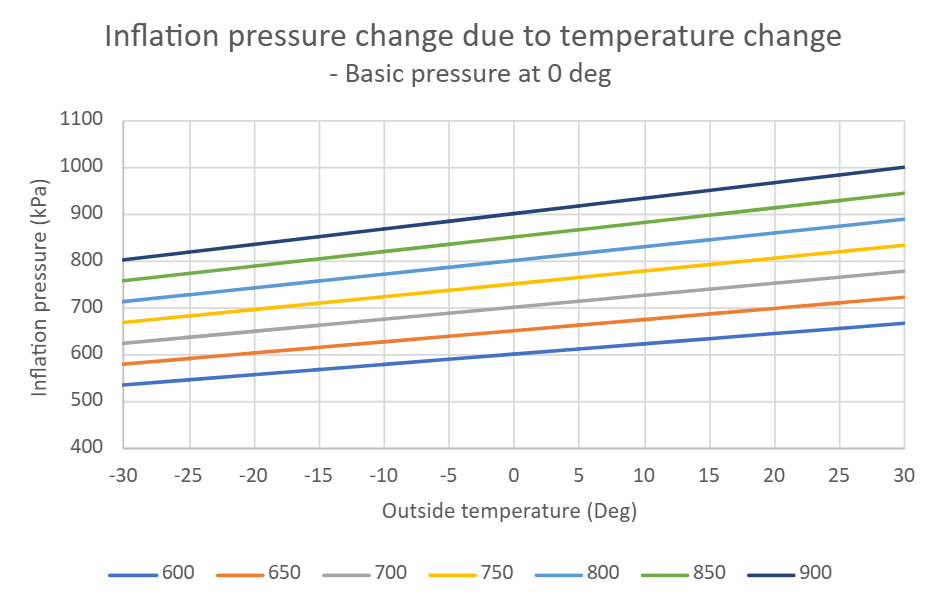
As the outside temperature drops, the air inside your truck tire contracts, causing the inflation pressure to decrease. During winter, a truck tire that was perfectly optimized in a warm workshop can quickly become dangerously underinflated on the road.
“Pressure checks must always be conducted on a cold tire — meaning a tire that has not been driven and is completely adjusted to the current ambient outdoor temperature.” - Teppo Siltanen, Senior Product Manager, Nokian Heavy Tyres.
Choose the correct truck tire pressure with Nokian Tyres Technical Manual
Every tire compound and tread configuration performs uniquely under pressure. To get the longest service life, lowest rolling resistance, and best safety metrics out of your commercial truck fleet, download the official Nokian Tyres Technical Manual. This comprehensive guide gives you precise, data-backed metrics to keep your commercial trucks moving efficiently across all seasons.
Frequently asked questions about truck tire pressure
What should my truck tire pressure be?
To determine the truck tire pressure, you must know the vehicle's tire size and its maximum axle load. With these specifications in hand, refer to the Nokian Tyres Technical Manual to locate the minimum required inflation value for that weight.
How to set proper tire pressure for my truck?
To set proper truck tire pressure, use a calibrated pressure gauge and a compressor capable of supplying adequate volume and pressure. For safety, never stand directly next to a tire during inflation, use an extended inflation hose, and always verify that the valve cores do not leak after completing the adjustment.
What is a truck tire pressure monitoring system?
A truck tire pressure monitoring system (TPMS) works similarly to passenger car variants but is adapted for commercial fleets using sensors mounted inside the tire or integrated directly into the valve stem. Fleet operators must verify that the sensors work across every wheel position and ensure that drivers never ignore a low-pressure alert.
What did you think?
0 Responses
Please remember that it is the driver’s responsibility to ensure their tires are safe and suitable for their vehicle and to follow the vehicle’s manufacturer´s guidelines for proper use and maintenance. Consult your closest Nokian Tyres dealer or your vehicle’s manufacturer for specific advice.